
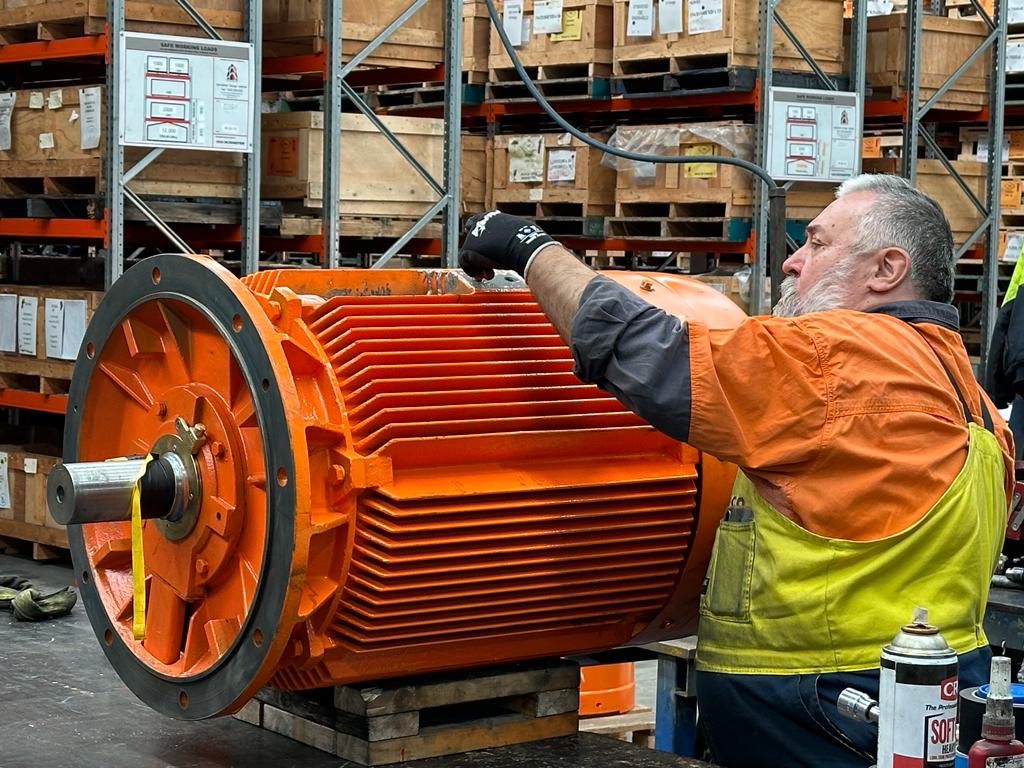
In the industrial context of Australia and New Zealand, electric motor energy efficiency cannot be assessed merely by referencing nameplate values or IE classifications. Laboratory conditions do not reflect the operational realities found across the regions, where high ambient temperatures, airborne contaminants, long supply feeders, variable speed drive (VSD) operation and fluctuating electrical conditions shape the true efficiency profile of a motor across its lifecycle.
What ultimately matters for engineering managers and asset custodians is the motor’s ability to maintain stable magnetic, electrical and thermal behaviour over years of service, not just during initial commissioning; a motor is a critical investment for the future.
Efficiency performance is governed by AS/NZS 1359, the AS/NZS/IEC 60034 framework and MEPS requirements, which define how efficiencies are tested and the minimum acceptable limits.
These standards provide a baseline reference, yet the operating environment in Australia and New Zealand demands motors capable of sustaining that performance under thermal stress, contamination, supply variations and long-duration loading.
It is in this practical scenario that TECO MAXeV4 IE4 Super Premium Efficiency motors, the TECO MAXe3 IE3 Mining motors and the TECO IE3 Flameproof (Ex d) range are engineered to operate, incorporating margins that enable stable behaviour far beyond test-bench conditions.
Sustained efficiency depends heavily on design elements that manage electrical and magnetic losses while maintaining structural and thermal integrity.
TECO electric motors are developed for the Australian and New Zealand market and employ high-grade magnetic lamination steels, optimised core geometries and robust rotor configurations to minimise inherent losses.
It’s equally important to maintain slip characteristics and torque–speed behaviour under real industrial loads, an area where TECO MAXeV4 rotor design supports predictable and efficient operation across extended duty cycles.
Their insulation systems, cooling structures and enclosure designs up to IP66 are aligned with IEC and AS/NZS specifications and are intended to withstand high ambient temperatures and contamination without compromising thermal stability. The highest rating available for both insulation and ingress protection is provided across the TECO motor platform.
The increasing prevalence of VSD-driven plant operation places additional demands on motor efficiency. PWM switching introduces non-sinusoidal flux patterns, dv/dt stress and reduced cooling effectiveness at lower speeds.
These factors shape the motor’s thermal trajectory and can accelerate loss growth if the machine is not designed for such conditions. TECO IE3 and IE4 motors are built to operate reliably under a wide range of VSD types and manufacturers, which is essential in multi-supplier environments, staged plant upgrades and asset fleets that evolve without drive-standardisation strategies.
From a lifecycle perspective, electrical conditions represent one of the most significant contributors to long-term efficiency drift. Negative-sequence voltages, harmonic interaction, reflected-wave behaviour on long cables and supply-network impedance variations all introduce secondary loss mechanisms that shift the motor’s thermal and magnetic balance over time. TECO MAXe3 and MAXeV4 machines incorporate insulation architectures and magnetic designs capable of maintaining stable behaviour under these operational stresses. This supports predictable performance on both weak regional networks and industrial installations with high harmonic content.
Mechanical influences on efficiency are equally important, particularly for assets managed over long service periods. Factors such as rotor dynamic stability, frame rigidity, thermal expansion behaviour, mechanical vibration and particulate-induced thermal obstruction influence not only immediate performance but also the rate at which efficiency degrades. TECO MAXe3 motors address these stressors with reinforced frames, engineered sealing systems, high-specification quality bearings and structural designs intended to maintain air-gap uniformity even in demanding environments. These characteristics are essential for ensuring that efficiency remains stable throughout the service life, rather than declining as mechanical and thermal stresses accumulate.
Environmental conditions in Australia and New Zealand amplify these lifecycle considerations:
The TECO MAXeV4, MAXe3 and Flameproof ranges integrate coating systems, tropicalised windings, robust mechanical structures and high-IP enclosures precisely to address these long-term environmental influences.
For engineering and asset managers, motor selection must align with long-term operational objectives rather than just short-term procurement criteria. Efficiency must be viewed as a lifecycle attribute shaped by electromagnetic behaviour, mechanical integrity, thermal performance, VSD compatibility, environmental exposure and maintenance strategy.
TECO’s presence in Australia and New Zealand through the TECO ModShop provides the ability to tailor motors to site-specific conditions, ensuring alignment between asset strategy and machine capability. Customisation, such as cooling-path modification, bearing system specification, terminal box configuration, enhanced surface protection and sealing strategies, allows motors to be optimised for long operational horizons without compromising compliance or functional performance.
Within this lifecycle and asset-management perspective, TECO MAXeV4 IE4, MAXe3 IE3 Mining and IE3 Flameproof (Ex d) motors provide a platform engineered for durability, efficiency retention and operational consistency in the demanding industrial environments of Australia and New Zealand. Their alignment with AS/NZS standards, combined with robust construction, universal VSD compatibility and on-shore local engineering adaptation capability, ensures that motors do not simply meet efficiency requirements at commissioning but maintain them as part of a stable, long-term asset investment strategy.
For more information, reach out to us here.

