
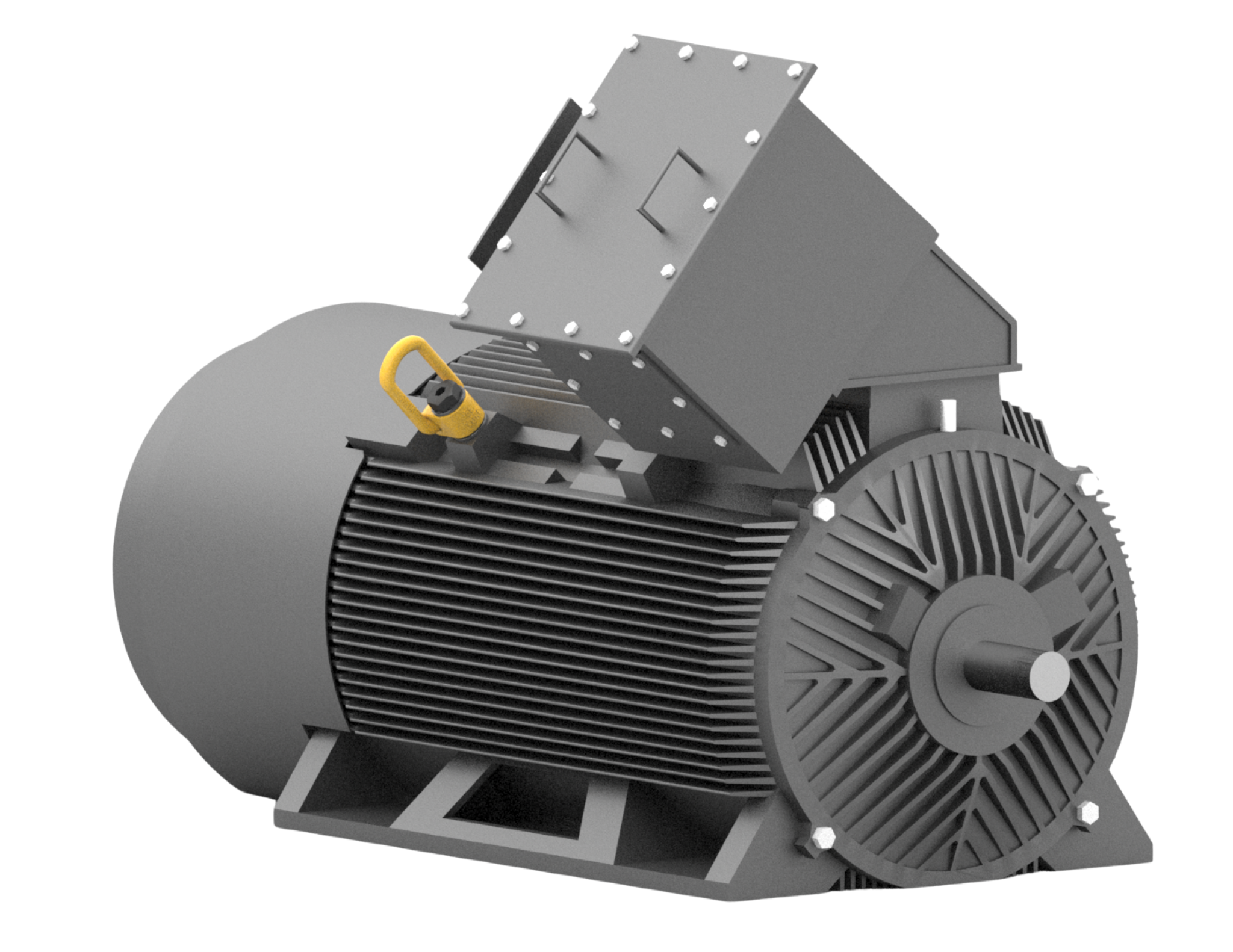
Custom-Designed TECO Squirrel Cage Motors
TECO Squirrel Cage Induction Motors are meticulously designed with precision engineering, ensuring outstanding performance efficiency and flexibility across various industries. A squirrel cage induction motor, also called a squirrel cage rotor motor, has a rotor manufactured with conductor bars short-circuited by end rings, with no brushes or slip rings. TECO squirrel cage motors on this page are medium and high voltage machines, custom-designed from 300 kW to 15,000 kW at voltages up to 13,800 V, in frames 315 to 1250. Cooling is TEFC in a cast iron frame or TEAAC in a steel fabricated frame, with a water-cooled option, ingress protection runs from IP56 to IP66. In mining they drive crushing and grinding circuits, conveyors, pumps and ventilation fans. They also run in oil and gas, water and wastewater, including pulp and paper plants. The motors are designed for use on a variable speed drive and can be built as a drop-in replacement. For low voltage applications such as pumps, fans and compressors, the TECO MAXeV4 squirrel cage induction motor covers from 0.75 kW to 315 kW: see the low voltage three-phase motors.
High-Efficiency Motors with Low Maintenance
One of the standout features of TECO Squirrel Cage Motors is their high efficiency and minimal maintenance costs. Leveraging advanced technology, we provide the most effective motor solutions within the high voltage electric motor range.
We engineer these motors to excel in demanding applications, enhancing the robustness and longevity of the motor.
Flexible Design for Seamless Integration
Our motors offer remarkable design flexibility, enabling effortless mechanical and electrical integration. Whether facing extreme temperatures, high humidity, or heavy vibrations, TECO Squirrel Cage Motors continue to perform at their best.They are also well-suited as direct replacements for existing applications.
TECO can reverse engineer various motor designs to replace other installed machines.
TECO motors meet global standards, integrating the latest advances in high grade insulation materials and designed to enable their use on variable speed drives.
Versatile Design Options for Safety and Efficiency
TECO Motors have many design options for different needs, from simple to complex requirements. They seamlessly blend cost-effective standard designs with swift delivery, ensuring safety, efficiency, energy conservation and reliability.
#BBD0E0
»
|
Product Overview
|
|
| Output | 300 up to 15,000kW |
| Number of Poles: | 2 to 12 |
| Cooling method: | TEAAC & TEFC |
| Degree of Protection: | IP54 to IP66 |
| Frames: | 315 up to 1250 |
| Ambient temperature: | 40 °C |
| Elevation: | 1000m above sea level |
| Service factor: | 1.0 @ 40 deg C ambient |
| Mounting: | IM1001 |
| Voltages: | Up to 13,800V |
| Insulation Class: | “F” insulation (ΔT = 80K) |
| Continuous duty: | S1 |
| Design: | N |
| Thermal protection: | As per customer specification |
| Bearings: | Anti-friction Bearings , Sleeve bearings |
| Frame Material: | Fabricated Steeel |
| Color: | As per customer specification |
|
Options Available
|
|
| Altitude above 1000 m (on request) | |
| Aluminum, copper or brass rotor | |
| Ambient temperature above 40 °C | |
| Base: rail, sliding base, extended feet, rebuilt feet, anchorage plate | |
| Bearing thermometer with gauge with/without contacts | |
| Cable gland in the terminal box entrance | |
| Class of insulation: H | |
| Classified area application: Ex-n, Ex-p | |
| Cooling: Forced ventilated, Air-to-water heat exchanger | |
| CT for differential and integral protection | |
| Electrically insulated bearing | |
| Encoder | |
| Grounding brush on drive end bearing | |
| Independent hydraulic oil circulation system for sleeve bearing | |
| Mountings: Vertical, Horizontal, Foot and Flange, Flange, NEMA Standard | |
| Noise suppressor in the air inlet and outlet | |
| Non-reversion ratchet | |
| Multiple accessory terminal boxes | |
| Power factor correction capacitors | |
| Protection against voltage surge: Lighting arrestors and Capacitors | |
| Service Factor: 1.15 | |
| Shaft: Special dimensions, double shaft end, tapered, hollow, special steel | |
| Signal transducer | |
| Sleeve bearing | |
| Special balance | |
| Special bearing (overdesigned) for axial or radial thrust | |
| Special painting | |
| Steel welded terminal box in different sizes, based on internal available space | |
| Temperature detector: Thermistor (PTC or NTC) | |
| Temperature detector: Thermostat (Bimetallic) | |
| Two energized power terminal boxes | |
| VFD application | |
| Vibration detector | |
| wdt_ID | wdt_created_by | wdt_created_at | wdt_last_edited_by | wdt_last_edited_at | KW Rating | Voltage | Phases | No of Poles | Frame | Datasheet PDF | Enquire |
|---|---|---|---|---|---|---|---|---|---|---|---|
| 1 | nate | 11/11/2024 12:36 PM | nate | 11/11/2024 12:36 PM | 220 | 3,300 | 3 | 2 | 315CA | https://electricmotors.teco.com.au/wp-content/uploads/sites/53/2024/04/Datasheet-716.pdf | |
| 2 | nate | 11/11/2024 12:36 PM | nate | 11/11/2024 12:36 PM | 220 | 3,300 | 3 | 4 | 315CB | https://electricmotors.teco.com.au/wp-content/uploads/sites/53/2024/04/Datasheet-733.pdf | |
| 3 | nate | 11/11/2024 12:36 PM | nate | 11/11/2024 12:36 PM | 220 | 3,300 | 3 | 6 | 315DB | https://electricmotors.teco.com.au/wp-content/uploads/sites/53/2024/04/Datasheet-753.pdf | |
| 4 | nate | 11/11/2024 12:36 PM | nate | 11/11/2024 12:36 PM | 220 | 3,300 | 3 | 8 | 355CB | https://electricmotors.teco.com.au/wp-content/uploads/sites/53/2024/04/Datasheet-717.pdf | |
| 5 | nate | 11/11/2024 12:36 PM | nate | 11/11/2024 12:36 PM | 250 | 3,300 | 3 | 2 | 315DA | https://electricmotors.teco.com.au/wp-content/uploads/sites/53/2024/04/Datasheet-772.pdf | |
| 6 | nate | 11/11/2024 12:36 PM | nate | 11/11/2024 12:36 PM | 250 | 3,300 | 3 | 4 | 315DB | https://electricmotors.teco.com.au/wp-content/uploads/sites/53/2024/04/Datasheet-734.pdf | |
| 7 | nate | 11/11/2024 12:36 PM | nate | 11/11/2024 12:36 PM | 250 | 3,300 | 3 | 6 | 315DB | https://electricmotors.teco.com.au/wp-content/uploads/sites/53/2024/04/Datasheet-754.pdf | |
| 8 | nate | 11/11/2024 12:36 PM | nate | 11/11/2024 12:36 PM | 260 | 3,300 | 3 | 8 | 355CB | https://electricmotors.teco.com.au/wp-content/uploads/sites/53/2024/04/Datasheet-773.pdf | |
| 9 | nate | 11/11/2024 12:36 PM | nate | 11/11/2024 12:36 PM | 280 | 3,300 | 3 | 2 | 315DA | https://electricmotors.teco.com.au/wp-content/uploads/sites/53/2024/04/Datasheet-718.pdf | |
| 10 | nate | 11/11/2024 12:36 PM | nate | 11/11/2024 12:36 PM | 280 | 3,300 | 3 | 4 | 315DB | https://electricmotors.teco.com.au/wp-content/uploads/sites/53/2024/04/Datasheet-735.pdf | |
| KW Rating | Voltage | Phases | No of Poles | Frame |
It is a three-phase AC induction motor whose rotor is a cage of conductor bars that are short-circuited by end rings. The stator induces a rotating magnetic field to the rotor, the rotor has no brushes, no slip rings and no external connection. TECO manufactures the medium and high voltage version on this page from 300 kW to 15,000 kW at voltages up to 13,800 V, for continuous duty (S1).
The difference is in the rotor design and construction. A squirrel cage rotor has bars short-circuited by end rings with no external connection. A slip ring motor, also called a wound rotor induction motor, has a wound rotor connected through slip rings and brushes that connects to an external resistance that limits starting current and controls starting torque and starting time. The brush gear wears and requires regular inspection and maintaining. A squirrel cage motor on a variable speed drive gets its controlled start from the drive: the drive smooths the inrush current during starting and removes abrupt starts and stops.
The rotor has no brushes, slip rings or external connections, so there is nothing on the rotor to inspect or wear apart from the bearings, and as such the motor suits long continuous duty. The same construction also suits hazardous areas: TECO TEFC and TEAAC squirrel cage motors are built for safe and hazardous area installation, with oversized anti-friction or sleeve bearings. On a variable speed drive the motor also gives a controlled start and speed control without any change to the rotor design.
Yes. TECO medium and high voltage squirrel cage motors are designed for use on variable speed drives, and the TECO MV510 medium voltage drive is built specifically for them: its multilevel H-bridge output waveform is near-sinusoidal, which keeps motor harmonics and torque pulsation low, with virtually no cable length limitation and no external filter required. The MV510 can also start several motors in turn and transfer each one synchronously to the network supply. TECO low voltage squirrel cage motors carry inverter-rated insulation as standard.
The three-phase stator winding, when energised, produces a magnetic field, which induces a rotating magnetic field to the short-circuited rotor bars; the interaction between the stator magnetic field and the rotor circuit in turn rotates the rotor assembly, a little below the synchronous speed of the field. No power is fed to the rotor, which is why there are no brushes or slip rings. Synchronous speed is fixed by the supply frequency and the number of poles, and TECO builds the range from 2 Pole high-speed machines to slow-speed high-polarity motors.
The name comes from the rotor: the conductor bars joined by an end ring at each end, seen removed from the laminated iron core, looks like the cylindrical exercise wheel once sold for pet squirrels; hence, squirrel cage. The name describes the rotor only; the stator is the same as in any other three-phase induction motor.


