
Medium voltage (MV) variable speed drives (VSDs) on large process loads carry significant risk when they fail. On a SAG mill, ball mill, conveyor or major pump station, unplanned downtime can cost tens or hundreds of thousands of dollars per hour. That is the direct production loss alone, before considering any indirect costs.
When an MV VSD is the cause of the downtime, its topology and construction directly affect how quickly it can be returned to service and, more importantly, by whom.
TECO’s MV510 and MV550 drives are designed with a cascaded H-bridge (CHB) topology. The output voltage is built up by connecting multiple low-voltage power cells in series across each phase.
Each cell is fed from its own isolated transformer winding at low voltage (approximately 450–700 V, depending on the specific design), using standard IGBT technology.
Stacking these cells produces a stepped, multilevel output waveform that closely mimics a supply system sine wave. Therefore, output filtering is generally not required.
On the supply side, the multi-pulse phase-shifting input transformer typically keeps harmonics at the point of common coupling within IEEE 519 limits without input filters.
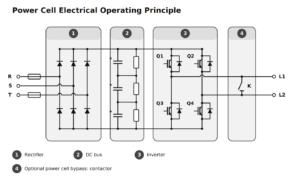
From a reliability and serviceability perspective, each power cell is a self-contained, withdrawable unit.
Once the MV supply is isolated and earthed under site HV procedures, and the DC bus has discharged, a cell change is a straightforward mechanical task. This involves disconnecting the power and fibre-optic connections, removing the mounting screws and sliding the cell out, with the support of mechanical lifting aids due to its weight.
Qualified site electrical personnel can perform this work by following the installation, operation and maintenance (IOM) manual.
TECO MV550 power cells incorporate dry-film capacitors, which means spare cells can be held on-site and treated as standard electrical spare inventory. If a cell fails, a replacement can be taken directly from stores without the need to reform and can be installed by the site electrical team.
There is no requirement to wait for a factory-trained technician to travel to site. These features all contribute to the speed at which the VSD can be repaired and brought back online.
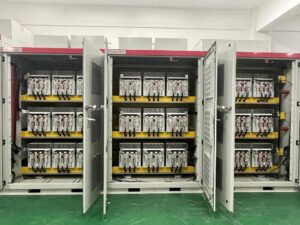
Both the TECO MV510 and TECO MV550 offer optional cell bypass functionality.
When cell bypass is included, if a cell fails, the failed cell is automatically shorted and bypassed. Critically, this means the VSD typically does not trip or stop the process.
The VSD continues to operate at reduced output voltage and, therefore, reduced output power while a replacement cell is organised and a short downtime window is planned to replace the faulty cell.
Taking things a step further, the TECO MV550 can be supplied with N+1 power cell redundancy.
This feature means one additional cell is installed in each phase. In the event of a power cell failure, the failed cell is bypassed, with the additional cell ensuring the site can continue its process at full power output.
For electrical engineers working on projects where continuity of operation is critical, understanding the architecture and serviceability of the Medium Voltage Variable Speed Drive (MV VSD) being selected can be worth millions of dollars over the operational life of the plant.