
Specify and select a three phase motor in this order: load and duty, then the drive arrangement, then the site, and only then the efficiency class and the frame. Wrong selections usually consider this backwards, starting from the frame of the old motor or the IE class in the tender.
Send us the load torque curve from standstill to full speed, the inertia on the shaft and the duty cycle. Our stock motors are rated S1 continuous duty to IEC 60034-1; for any other duty we size the motor from the load demand frequency, the torque required during acceleration, the load inertia and the type of braking.
Each direct on line start generates heat into the stator windings and more importantly the rotor assembly, therefore, starts per hour required are a sizing question. On the TECO MAXe3 the permitted number of starts depends on frame and load inertia, these are counted as equally spaced starts which includes the first cold start; beyond that we size the motor to the duty. The MAXe3 Mining also has as standard a 1.2 service factor at 40°C, this is the margin that a crusher or a conveyor restart draws upon.
Stock TECO motors are built to Design N to IEC 60034-12. If the load needs more torque at standstill, change the motor or the starting method; a bigger frame on its own does not always fix it.
Advise pulley sizes, belt tension and overhang on the enquiry, because they dictate the bearing arrangement in particular the drive end bearing. Apart from 2 Pole motors above frame D180, the TECO Te3 range is specified for direct coupling and vee belt drive, and we check the bearing against any belt load. The TECO MAXe3 range takes direct or belt drive from 4 Pole and larger up to D315MC, the Mining version on 250 frame and above has a roller bearing at the drive end. An excessive belt load on a ball bearing arrangement will eventually fail whatever the efficiency class.
Once kW and Poles are selected, so is the IEC frame. The TECO MAXeV4 keeps IEC 60072-1 mounting dimensions from frame 80 to 355L, so an IE4 upgrade goes onto the same feet, shaft height and coupling as the motor it replaces. Check the actual frame where the old motor sits to ensure it matches: on the TECO Te3, 110 kW 2 Pole and 75 kW and 110 kW 4 Pole use 250M and 280M frames, and the TECO AFJE/AFJN puts 250 kW to 315 kW in a special 315LL frame to match other motors in the market, complete with a Class B rise.
Ratings assume 40°C and 1,000 m. Above either, multiply rated output by our temperature and altitude factors; for the TECO MAXe3 the altitude factor is 0.97 at 1,500 m, 0.945 at 2,000 m, 0.89 at 3,000 m and 0.74 at 4,500 m.
Temperature buffer is where the gap between insulation class and temperature rise matters. The TECO MAXe3 Mining is Class H with a rise under 80 K, with under 75 K on most frames, and holds full output up to 60°C ambient. The TECO Te3 is Class F with a Class B temperature rise and is rated from -20°C to +50°C; the Te3 Severe Duty is Class H. That gap is what a hot afternoon, direct sun exposure, a voltage dip or an overload uses up before it breaches the overall insulation thermal rating.
Decide winding protection at the same time: PTC thermistors from frame D160 on single speed TECO Te3 and TECO MAXe3, PTC 150°C from frame 160 on the TECO MAXeV4, and PT100 RTDs in the windings or bearings fitted by our TECO ModShop where the site standard asks for them, usually from 250 kW.
IP55 for plantrooms and general industry, as on the TECO Te3 (IP56 & IP66 on request). IP66 for washdown, coal dust and outdoor mining is provided on: TECO Te3 Severe Duty, TECO MAXe3 and TECO MAXeV4. Our open drip proof range (IP23, 7.5 kW to 765 kW) belongs indoors in clean air, where its cooling gives a thermal margin a totally enclosed frame of the same kW size cannot match. Specify the terminal box with the motor: the Te3, MAXe3 and MAXeV4 main terminal box has its own IP66 rating and rotates in 4 x 90° steps.
Every TECO three phase stock motor meets or exceeds MEPS and IEC 60034-30-1 standards where they apply. The TECO MAXe3 and Te3 are IE3; the TECO MAXeV4 is IE4 from 0.75 kW to 315 kW. Running hours decide: energy consumed is around 95% of a motor's lifetime cost, so on continuous pump, fan or conveyor duty the IE4 pays back in kilowatt-hours, and on a motor that runs a few hundred hours a year it does not. TECO stock both.
All three ranges run on a VSD within the torque and speed limits of the load: variable torque loads from 5 to 50 Hz without derating, inverter-rated insulation is provided as standard.
Stock motors are wound for 380 V to 415 V at 50 Hz and suit 440 V to 480 V at 60 Hz; we wind to order up to 1,100 V. TECO Te3 motors up to 3 kW and TECO MAXe3 up to 4 kW, are star connected and can be reconnected to 240 V delta for single phase input drives, for TECO Te3 4 kW and TECO MAXe3 5.5 kW and above are delta connected. Check the nameplate before ordering a star-delta starter: the motor has to be delta rated at the supply voltage.
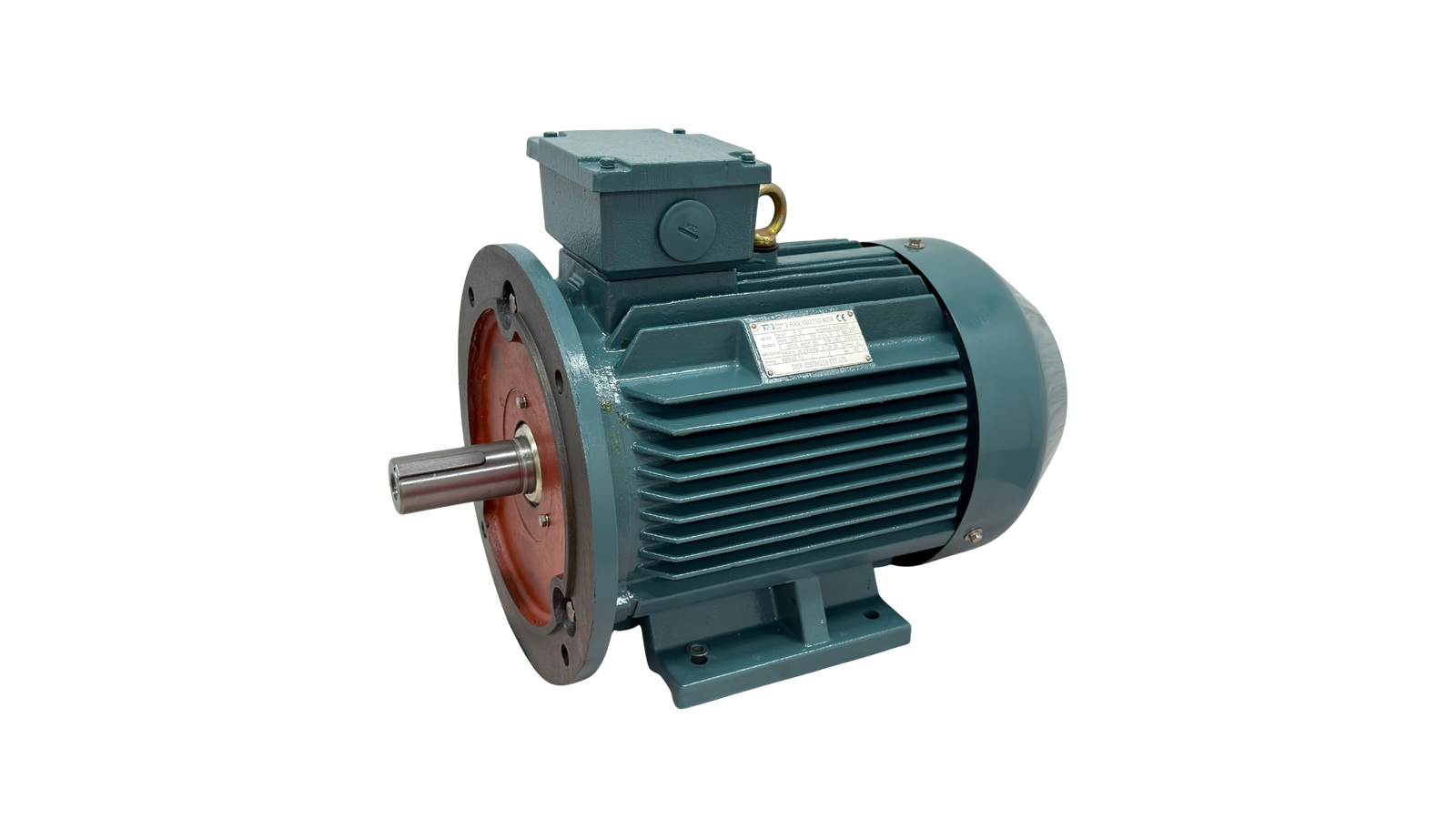
An AC motor supplied from three phases 120 degrees apart, which together produce a rotating field; the squirrel cage induction motor is the most common standard industrial type. TECO three phase motors run from 0.18 kW to 500 kW in the low voltage ranges.
An induction motor whose rotor is a cage of conductor bars short-circuited by end rings, this is typically pressure die cast in aluminium on TECO low voltage motors. There is no electrical connection to the rotor, so there are no brushes and no slip rings to maintain.
From the load torque curve, the inertia and the duty cycle, then the ambient and altitude, then the drive arrangement; the kW rating and the frame follow. For duties other than S1, send us the load demand frequency, the torque required during acceleration, the load inertia and the type of braking.
These are two efficiency levels under IEC 60034-30-1. TECO MAXe3 and Te3 are IE3; the TECO MAXeV4 is IE4 from 0.75 kW to 315 kW. Both exceed the Australian and New Zealand MEPS minimum.
IP55 for plantrooms and general industry, as on the TECO Te3. IP66 for washdown, coal dust, outdoor and mining duty, as on the TECO Te3 Severe Duty, MAXe3 and MAXeV4 range of motors.
Send the load data, the duty cycle, the site ambient and altitude and the drive arrangement through the Contact us page. These motors are stocked in Australia and New Zealand, and our TECO ModShop network modifies them locally, from terminal box orientation and shaft changes to heaters, RTDs and two-pack paint. The low voltage range is on the TECO 3 phase electric motors page, and the full range of TECO electric motors covers low, medium and high voltage.
Most industrial motor failures end in a winding or a bearing issue, and most of them start to fail months earlier, in the specification, the installation or the maintenance routine.
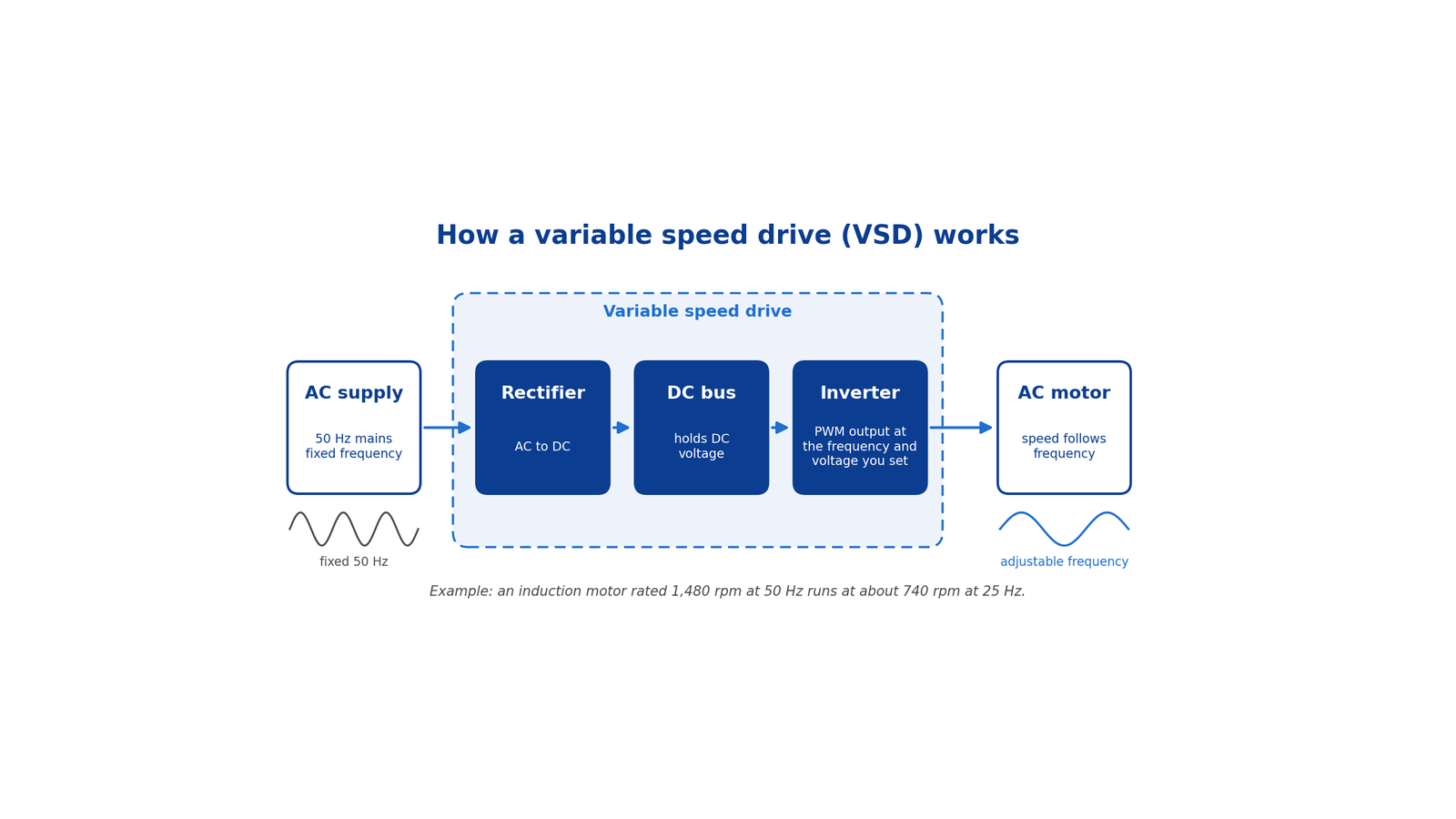
A variable speed drive (VSD) is a power electronic controller that sets the speed of an AC motor by varying the frequency and voltage it supplies, instead of running the
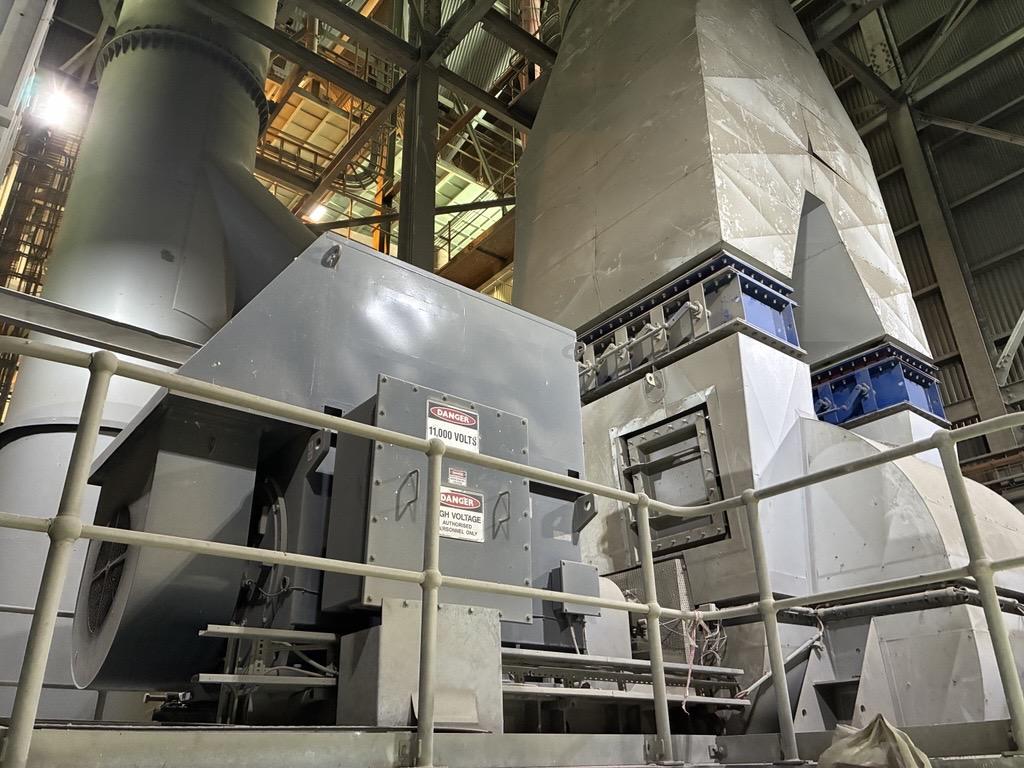
Most electrical engineers and industrial electricians have worked with low voltage (LV) motors throughout their careers, from a 4-copper-wire 15 V HVAC fan in an office building to an irrigation