A variable speed drive (VSD) is a power electronic controller that sets the speed of an AC motor by varying the frequency and voltage it supplies, instead of running the motor at the fixed speed set by the 50 Hz mains. The same device is called a variable frequency drive (VFD), an AC drive or an inverter drive; they are one product. TECO low voltage variable speed drives cover ratings up to 600 kW on 380 to 480 V three phase supplies, with single phase 200 to 240 V input on the smaller models.
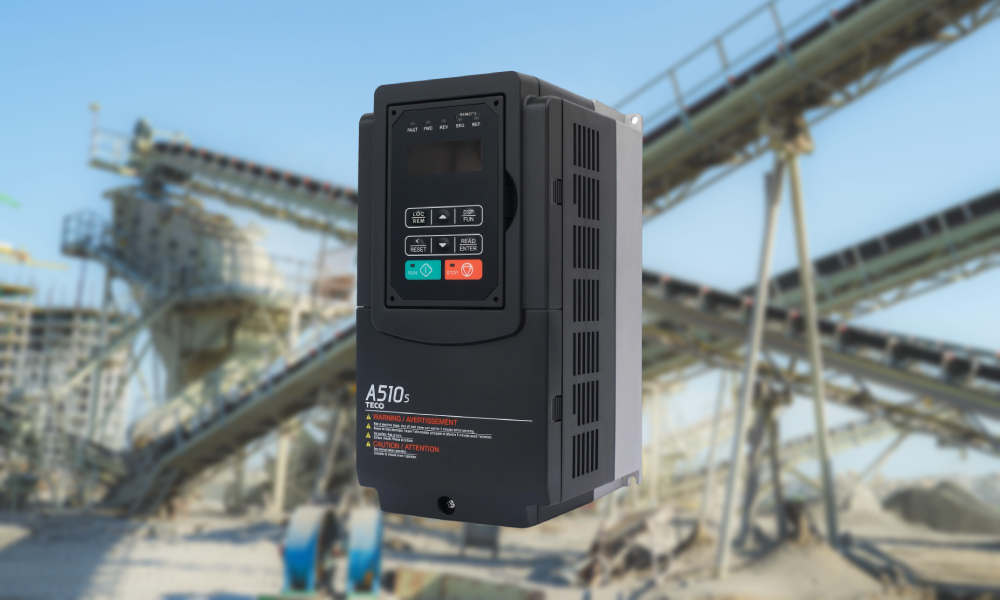
VFD describes the method: the drive changes the frequency. VSD describes the result: the motor speed changes. AC drive is the catalogue term many manufacturers use, and inverter refers to the output stage. On a specification, on a datasheet and on an enquiry form, the four terms mean the same thing, and the TECO F510, TECO A510s, TECO E510s, TECO E710 and TECO L510s answer to all of them.
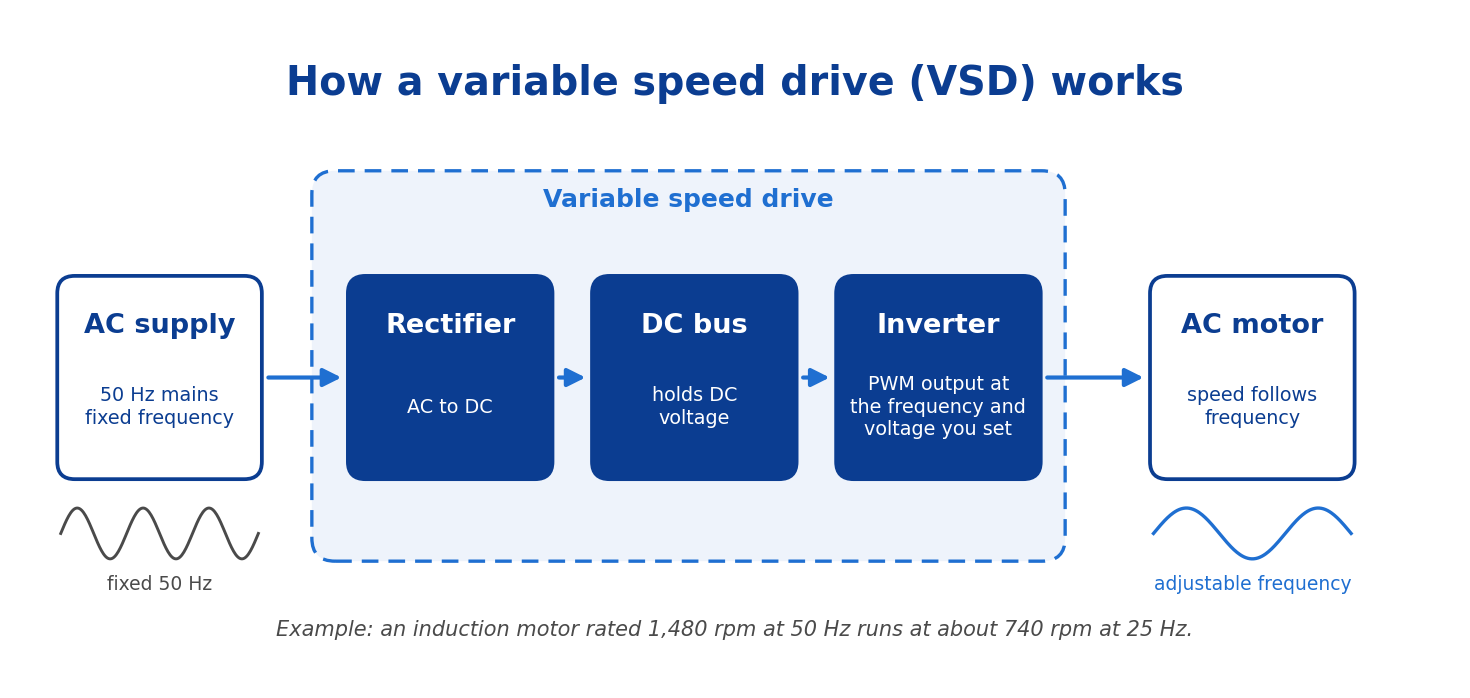
The drive rectifies the incoming AC supply to DC, holds it on a DC bus, and an inverter stage switches that DC into a pulse width modulated output whose fundamental frequency and voltage the control sets. The motor sees an adjustable frequency, so an induction motor rated 1,480 rpm at 50 Hz runs at about 740 rpm at 25 Hz. How the control calculates the output is what separates drive types: TECO drives offer V/F control, sensorless vector and closed loop vector control, and the TECO A510s offers seven control modes in one drive, including control of permanent magnet and synchronous reluctance motors as well as squirrel cage induction motors.
| Control mode | Full name | TECO A510s | TECO F510/E510s | TECO L510s | TECO E710 |
|---|---|---|---|---|---|
| V/F | V/F control without PG | ✓ | ✓ | ✓ | ✓ |
| V/F+PG | V/F control with PG (speed compensation) | ✓ | ✗ | ✗ | ✗ |
| SLV | Sensorless vector control | ✓ | ✓ | ✓ | ✓ |
| SV | Closed loop vector control with PG | ✓ | ✗ | ✗ | ✗ |
| PMSV | PM vector control with PG (permanent magnet motors) | ✓ | ✗ | ✗ | ✗ |
| PMSLV | Sensorless current vector control for permanent magnet motors | ✓ | ✓ | ✗ | ✓ |
| SLV2 | Voltage vector control without PG | ✓ | ✗ | ✗ | ✓ |
On a centrifugal pump or fan, flow follows speed and absorbed power follows the cube of speed, so a 20% speed reduction roughly halves the shaft power where the system allows it. That is the energy case, and across a motor's life energy accounts for around 95% of its total cost (IEA Electric Motor Systems Annex, quoted in the TECO MAXeV4 brochure).
The mechanical case is the ramp. A direct on line start applies full torque at once; a drive ramps current and torque up over a set time and ramps them down again on the stop, so couplings, belts, gearboxes and pipework see no step. On pumps a controlled deceleration is what removes water hammer; on conveyors a controlled acceleration is what keeps belt tension inside its design.
The control case is the process. A drive holds a pressure, a level or a flow through its built-in PID controller, stages several pumps, follows a schedule or a building management system, and reports what the motor is doing over the network. The TECO F510 runs up to four pumps natively and eight with a pump cascade card, with BACnet, Metasys N2 and Modbus built in; the TECO A510s carries integrated PLC and PID functions.
Load type decides the duty rating. TECO low voltage drives carry normal duty and heavy duty ratings: variable torque loads such as pumps and fans sit on normal duty, and constant torque or high inertia loads such as conveyors, crushers and cranes on heavy duty. The TECO A510s is the current vector drive for the second group, with 200% starting torque at 0.5 Hz; the TECO F510 is the pump and fan drive for the first.
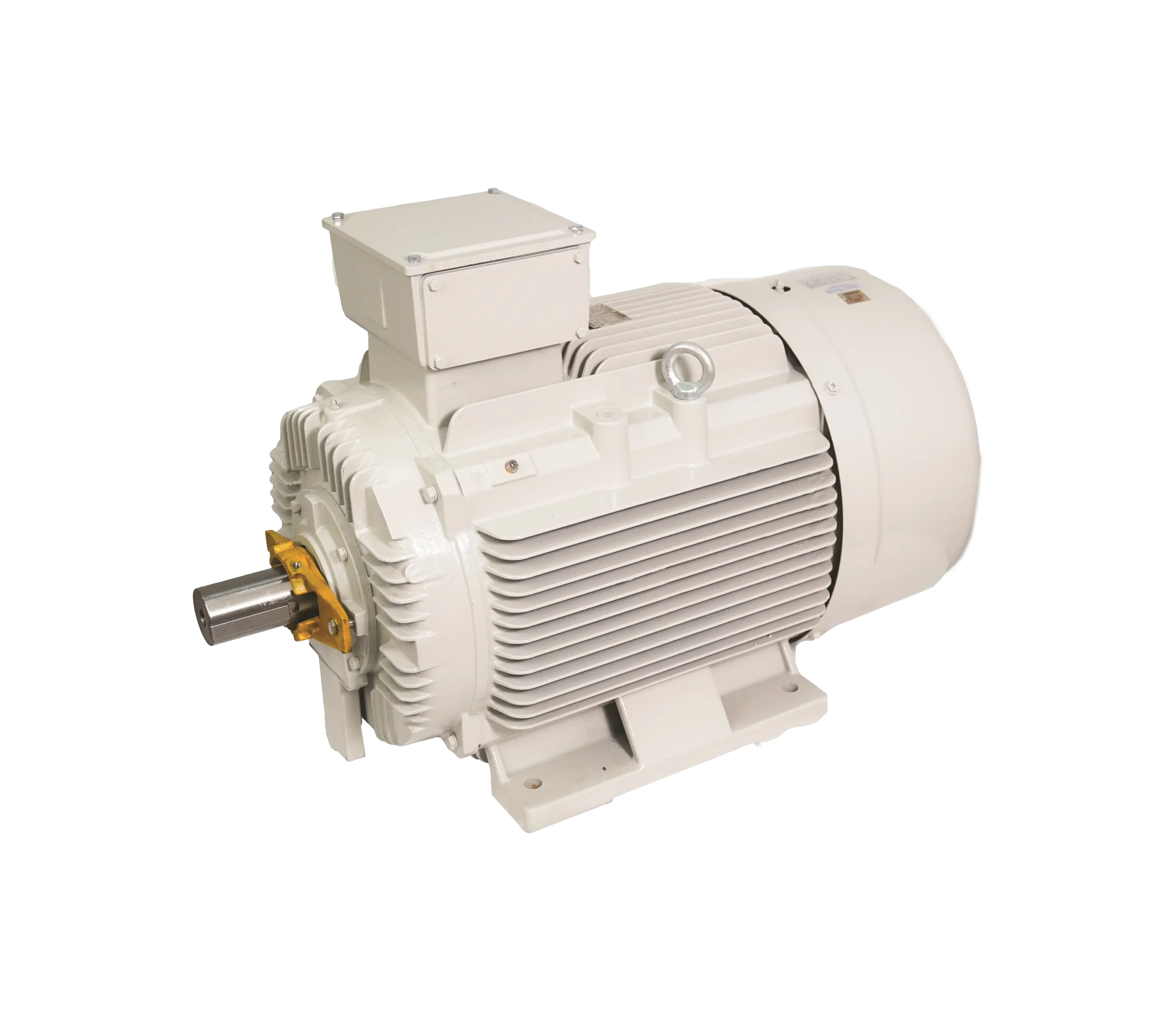
The motor must be rated for drive duty. The drive output is not sinusoidal and puts higher voltage stress on the windings. TECO low voltage stock motors are rated for it (Class F insulation withstands peak voltages up to 1,600 V and dV/dt up to 6,500 V/µs at the terminals, Class H up to 2,200 V and 8,500 V/µs), and an older motor from another construction has to be checked against the same limits. Long cable runs raise the peak voltage at the motor terminals, which is why the TECO F510 has a built-in filter up to and including 45 kW and an external filter above that.
Shaft currents are the quiet failure on drive-fed motors. For larger motors TECO recommends a shaft earthing brush on the drive end, an insulated bearing on the non-drive end from frame 280, and a carrier frequency of 5 kHz or below, or a common mode voltage filter at the drive output. Installation follows AS 60034.17 and IEC 60034.25.
Speed range sets the cooling. A totally enclosed fan cooled motor cools itself from its own shaft fan, so a variable torque load can run from 5 Hz to 50 Hz on TECO Te3 and TECO MAXe3 Mining motors without derating, while a constant torque load at low speed needs a motor rated for it or forced cooling.
Environment sets the enclosure. TECO variable speed drives come in IP00, IP20, IP55 and IP66 housings on selected models: IP00 and IP20 for a switchboard, IP55 and IP66 for a pump house or a washdown area without a separate cabinet. Safety functions and communications are checked at the same time: TECO low voltage variable speed drives have built-in Safe Torque Off (STO) to SIL2 and built-in PLC functionality, and cater for most communication protocols.
And the honest case for not fitting one: a load that runs at full speed all day, with no control requirement, is better served by a soft starter for the start and a contactor for the run. A drive on that duty adds losses, harmonics and cost for no return.
Grouped by load behaviour rather than by industry: variable torque loads (centrifugal pumps, fans, blowers, cooling towers, HVAC air handling), where the energy case leads; constant torque loads (belt conveyors, screw feeders, mixers, extruders, positive displacement pumps), where the ramp and the low speed torque lead; high inertia and overhauling loads (crushers, mills, cranes, hoists, winders), where four quadrant control and braking lead; and multi-pump and process duties (water and wastewater, irrigation, building services), where staging and PID lead. TECO drives are used across mining, water and wastewater, food and beverage, HVAC, cement and quarrying.
Above low voltage, the TECO MV510 medium voltage drive covers mill and pump duties with a built-in dry type isolation transformer.
All low voltage drives are stocked in Australia and New Zealand.
Variable speed drive. VFD stands for variable frequency drive; the two names describe the same device, one by its result and one by its method.
By matching motor speed to demand instead of throttling or bypassing. On centrifugal pumps and fans the absorbed power falls with the cube of speed where the system head is mostly friction; where static head dominates, the saving is smaller and should be sized from the system curve.
To any TECO low-voltage stock motor, within the load's torque and speed limits and with correct installation, because inverter-rated insulation is standard. For other motors, check the insulation against the peak voltage and dV/dt limits above, and for larger motors fit shaft current protection.
A soft starter controls start and stop, then runs the motor at full speed; a VSD controls speed throughout. Fixed speed with a gentle start: soft starter. Variable flow, pressure control, pump staging or low-speed torque: VSD. TECO supplies both, and the enquiry form on the Contact us page covers either.
Send the motor nameplate, the load and the site conditions through the Contact us page. The full range is on the variable speed drives page, matched to the range of TECO electric motors.