
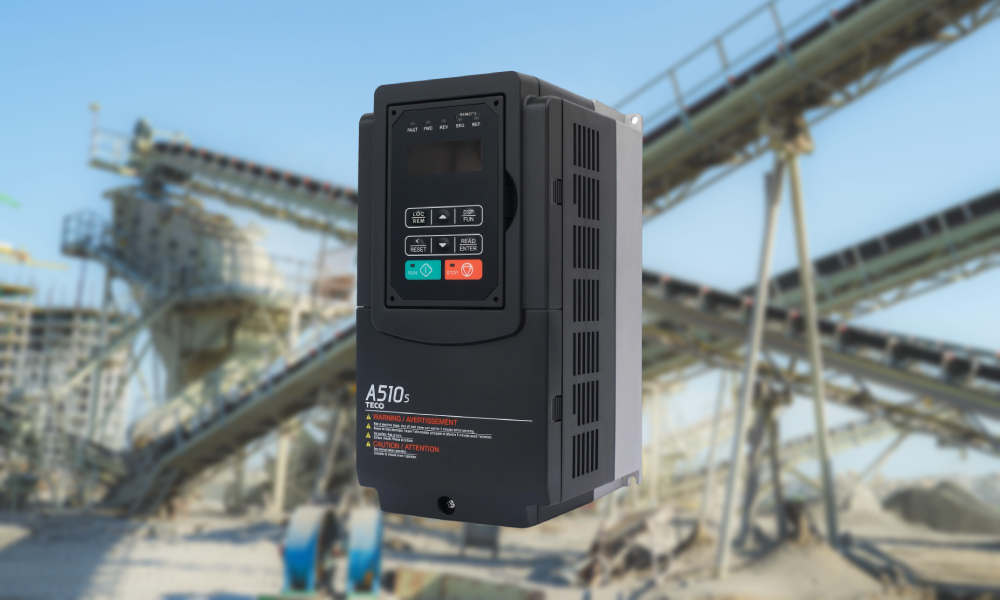
The TECO A510s is a current vector control variable speed drive, known in some plants as a variable frequency drive or VFD, built for the loads that are hard on a drive: high breakaway torque, frequent starts, overhauling loads, and continuous duty in dust, heat and remote conditions. It runs a sensorless vector algorithm on a dual-core platform (32-bit MCU plus ASIC), holding torque accurately down to low speed without an encoder. IP20 covers standard cabinet installs; IP00 open-frame is for panel builds where you control the enclosure and cooling.
Most VSD selections fail for one of two reasons: not enough torque at the speed the load actually starts, or undersized for the duty so it trips or derates in service. The TECO A510s is built around both.
The TECO A510s delivers up to 200% torque at 0.5 Hz. On a four-pole motor that is about 15 rpm, so you get full-load starting torque at crawl speed. That is where it earns its place: a loaded conveyor breaking away with a full belt after a shutdown, a choked crusher, a positive-displacement pump against static head, a mixer starting in a setting product. The kinds of loads a V/Hz VSD stalls on.
Four-quadrant control covers the other hard case — loads that drive the motor. Winches paying out, downhill conveyors, cranes lowering, centrifuges coasting. The TECO A510s holds speed on the overhauling side instead of letting the load run away. Overhauling loads may require dynamic braking resistors, depending on the braking duty and application requirements.
The TECO A510s supports positioning functions and multiple control modes on the same hardware platform, so one platform covers speed, torque and positioning without a hardware change.
The TECO A510s carries dual ratings, normal duty (ND) and heavy duty (HD), and choosing between them is the selection decision that matters most. A 45 kW ND VSD is not a 45 kW HD VSD: HD trades nominal kW for higher continuous and overload current, which is what breakaway-heavy loads draw.
Size on ND for variable-torque loads (centrifugal pumps, fans). Size on HD for constant-torque and high-inertia loads (crushers, conveyors, PD pumps, mixers). Sizing a high-breakaway load on the ND figure is one of the most common causes of nuisance overload trips.
PLC logic and PID are built in. For standalone duties such as a booster pump maintaining pressure, a fan trimming to a setpoint, or a sequenced start, the built-in PLC logic and PID can eliminate the need for an external controller: less panel hardware, less wiring, and fewer potential failure points on small skids and packaged plant.
For integrated plant, Modbus RTU over RJ45 is built in for setpoint, run/stop and diagnostics. An LCD keypad handles commissioning, and a parameter lock stops a commissioned VSD from being altered on site.
IP20 mounts in a standard cabinet and includes a built-in EMC filter up to 45 kW, holding conducted emissions in check without an external filter on most installs; above that rating, an external filter is used.
IP00 is open-frame, for panel builders designing their own enclosure. You engineer the cooling for the real ambient instead of accepting a fixed enclosure, but ingress protection and thermal design are then yours to own. On dirty sites, IP00 in a sealed, air-conditioned panel is often more reliable than a higher-rated standalone unit in a poorly sealed cabinet.
VSDs fail in service, not on the bench, and ANZ conditions are hard on them:
Constant- and variable-torque duties across cement, oil and gas, food and beverage, HVAC, lumber and milling, machine building, marine, metals, mining, power generation, pulp and paper, rubber and plastics, water and wastewater, and general industry.
Specified across a broad range of motor-driven equipment, TECO A510s earns its keep on the loads that punish an undersized or V/Hz VSD:
V/Hz has no direct control of torque, so it struggles at low speed and under load. Vector control regulates torque directly, holding it down to near-zero speed. On the TECO A510s that is 200% at 0.5 Hz — enough to start a fully loaded constant-torque machine.
IP20 for standard cabinet installs, with an integrated EMC filter on models up to 45 kW. IP00 open-frame for custom MCC and panel builds where you want control of the cooling and enclosure.
ND for variable-torque loads (centrifugal pumps, fans). HD for constant-torque and high-inertia loads (crushers, conveyors, PD pumps, mixers). Sizing a high-breakaway load on ND is the usual cause of overload trips.
A soft starter only manages the start. No speed control, no energy recovery. Choose a VSD when the process needs speed control, when the load overhauls and needs four-quadrant control, or for energy savings on variable-torque loads, where power falls with the cube of speed.
The TECO A510s is supported by TECO across Australia and New Zealand, with local stock and technical support.