
A variable speed drive (VSD) earns its place when pump flow demand varies throughout the day and the pump would otherwise be throttled or repeatedly cycled. In water and wastewater plants the selection usually goes wrong in one of two ways. The drive is often sized on motor kilowatts alone, without considering whether the load is variable-torque or constant-torque, or the enclosure and the SCADA connection are left until the switchboard is already built.
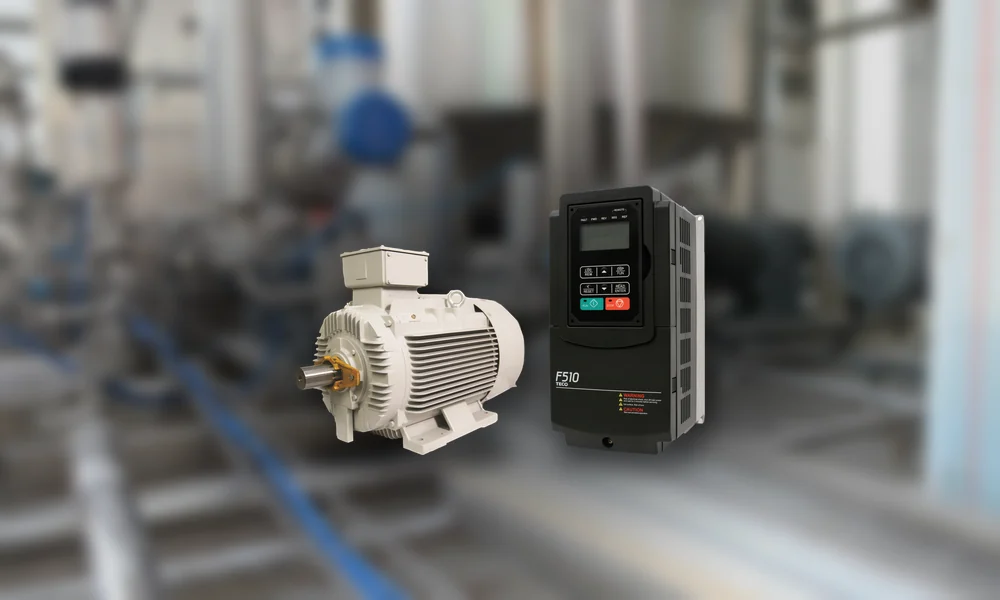
This guide works through VSD pump and blower duties by load behaviour, then the enclosure, cabling and communications points to settle before the order. The product data comes from the TECO F510 pump and fan drive, part of the TECO variable speed drives range: 380 to 480 V three phase, 0.75 to 45 kW in IP55 and 55 to 600 kW in IP00 with IP20 optional.
On a centrifugal pump working mainly against pipe friction, shaft power falls with the cube of speed: at 80% speed the pump requires roughly 51% of full-speed power. That is the case for a recirculation loop or a long, flat transfer main that would otherwise be throttled.
Most water duties also carry static head: the lift out of a wet well, a reservoir above the pump station, a filter that needs a minimum pressure. Reducing speed does nothing to static head. Where static head makes up most of the duty, the pump stops delivering well before 50% speed, the usable speed range is narrow, and the saving is smaller than the 51% figure suggests. Run the estimate on the system curve, with static head included, before quoting a payback.
At sustained light load the TECO F510 adds an automatic energy saving function, which lowers output voltage and current to suit the load.
These are variable-torque loads and sit on the normal-duty rating. The TECO F510 carries a single normal-duty rating with 120% overload for one minute, and 150% starting torque at 0.5 Hz in sensorless vector mode. Its built-in PID controller takes a 0-10 V or 4-20 mA transducer signal and holds pressure at setpoint, so a booster or filter feed set runs without a separate pressure controller. Three pump functions do most of the work on these duties:
For multi-pump stations, the built-in multi-pump mode links a master drive with up to three follower drives and evens out run hours between the pumps. An optional pump card (JN5-IO-8DO) extends cascade control to eight pumps.
A progressive cavity pump, like other positive displacement pumps, is a constant-torque load with a high breakaway demand, and its power falls in proportion to speed, not with the cube. Size it on a heavy-duty rating. In the TECO range that is the TECO A510s: dual rated, with 150% overload for one minute and 200% for two seconds on heavy duty, 200% starting torque at 0.5 Hz, from 0.75 to 315 kW. For dosing and small sludge pumps up to 22 kW, the TECO E710 is heavy-duty rated at 150% for one minute. The TECO F510 is rated for normal duty only, so check the overload margin with TECO before putting it on a positive displacement pump.
Centrifugal blowers are variable-torque loads and suit the TECO F510 on the same basis as centrifugal pumps. Its skip frequency setting steps over a speed band where the blower or its ductwork resonates. Where the plant PLC or SCADA system trims blower speed to a dissolved oxygen setpoint, the drive takes its speed reference from an analogue input or via various communication protocols. Positive displacement blowers such as rotary lobe machines are constant-torque loads. Treat them like the positive displacement pumps above and size on a heavy-duty rating.
Take a lift station with two submersible pumps, low inflow overnight and sharp morning and evening peaks. Run at fixed speed on level switches, each pump starts, empties the well at full flow and stops, repeatedly through each peak.
With a TECO F510 on each pump, the 4-20 mA signal from the wet-well level transmitter can be used as PID feedback and pump speed follows inflow. The pump runs longer at lower speed, and the rising main and the treatment plant inlet see a steadier flow. Overnight, when inflow drops below what the pump delivers at minimum speed, sleep mode stops the pump and the wake-up function restarts it as the level recovers. The multi-pump mode shares run hours across the two drives, and blockage detection flags a pump that is clogging.
Two settings decide whether this works. Set the minimum frequency above the speed at which the pump stops delivering against the static head of the rising main; below that point the impeller turns without moving sewage. Then set up the momentary power loss restart, adjustable up to two seconds, with speed search, so the pump returns to duty automatically after a supply dip.
From 0.75 kW to 45 kW the TECO F510 is available in IP55, allowing the drive to be mounted closer to the pump in suitable environments. From 55 kW to 600 kW it is IP00 as standard with IP20 optional and belongs in a switchroom or motor control centre. Three figures from the manual matter on water sites:
On the motor side, the TECO MAXe3 Mining range is IP66 from 0.18 kW to 450 kW. TECO also supplies IE3 and IE4 efficiency options, hazardous area motors, and encapsulated windings for motors at risk of immersion or flooding. The water and wastewater industry page lists the motor ranges.
Bore pumps and remote wet wells put long cable runs between drive and motor. The TECO F510 manual calls for a lower carrier frequency or an output filter once the motor cable exceeds 25 m. It caps the carrier frequency at 10 kHz for 30 m to 50 m, 5 kHz for 50 m to 100 m and2 kHz beyond 100 m. Measure the run before the drive is ordered.
An EMC filter is built in up to and including 45 kW, with an external filter above that. The 400 V models from 90 kW to 315 kW include a DC reactor, and the manual recommends an AC line reactor where the supply source is 600 kVA or larger. Where the network operator sets a harmonic limit at the point of connection, raise it at enquiry stage so reactors or filters are specified with the drive.
The TECO F510 has RS-485 built in, with Modbus and BACnet MS/TP. Option cards add Profibus DP, TCP-IP, DeviceNet, CANopen, EtherNet/IP and EtherCAT. Hardwired, it offers 9 digital and 4 analogue I/O, a PTC motor temperature input and built-in Safe Torque Off (STO) to EN 61508 SIL 2. An optional 24 V DC power card keeps communication with the drive available when main power is off, which helps when a pump is isolated for maintenance and SCADA still needs to see the drive. If the plant standard is a protocol that is not on this list, say so at enquiry stage.
Select the drive on motor rated current, not on kilowatts alone: the TECO F510 catalogue requires the drive's output current rating to be the same or higher than the motor's. The drive runs induction motors in V/F or sensorless vector mode, and permanent magnet motors in PM sensorless vector mode.
Buying a TECO low voltage motor and a TECO low voltage VSD together qualifies for the Motor and VSD Package Extended Warranty: 36 months from delivery or 30 months from commissioning, whichever occurs first. It covers repair or replacement at an authorised TECO service centre and excludes removal, reinstallation, freight, site labour and consequential costs.
For medium voltage pump motors, the TECO MV510 medium voltage drive covers water and wastewater duty and connects to SCADA or DCS systems over Modbus, Profinet and Ethernet. For pumps that only ever run at one speed, a TECO soft starter with soft stop reduces the mechanical stress of starting and stopping and is the simpler choice.
It depends on how much of the duty is friction and how much is static head. On a friction-dominated centrifugal pump, running at 80% speed requires roughly 51% of full-speed power. On a pump lifting mostly against static head the saving is smaller, and on a positive displacement pump power falls only in proportion to speed. Check the system curve before estimating.
Match it to where the drive is mounted. For a pump room, the TECO F510 is available in IP55 from 0.75 to 45 kW. In a switchroom or motor control centre, the 55 to 600 kW units are IP00 with IP20 optional, and the room or enclosure provides the protection. The motor at the pump is a separate decision: the TECO MAXe3 Mining range is IP66.
Yes. The TECO F510 has a built-in multi-pump mode for a master drive and up to three follower drives, with run hours shared between the pumps, and an optional pump card for cascade control of up to eight pumps.
It puts the current rating, cable length and control mode checks with one supplier. With TECO it also qualifies for the Motor and VSD Package Extended Warranty of 36 months from delivery or 30 months from commissioning, whichever occurs first.
Send TECO the pump curve and system curve, the motor nameplate data, the motor cable length, the ambient at the drive location and the SCADA protocol, and the drives team will match a drive and motor to the duty. TECO Australia and New Zealand was founded in 1983 and holds low voltage variable speed drives in local stock. Contact TECO to discuss a project or request a quote, or see the full range of TECO electric motors and drives.
AS/NZS 1359 is the series of Australian and New Zealand standards that motor specifications and nameplates have referred to for decades. Many of its parts have since been superseded or
An IE4 induction motor reaches its efficiency class on a plain 50 Hz supply, with a contactor and an overload relay in front of it. The TECO MAXeV4 is tested
The efficiency class is set by the design and does not move with the way the plant is run. The TECO MAXeV4 is IE4 Super Premium Efficiency to IEC 60034-30-1